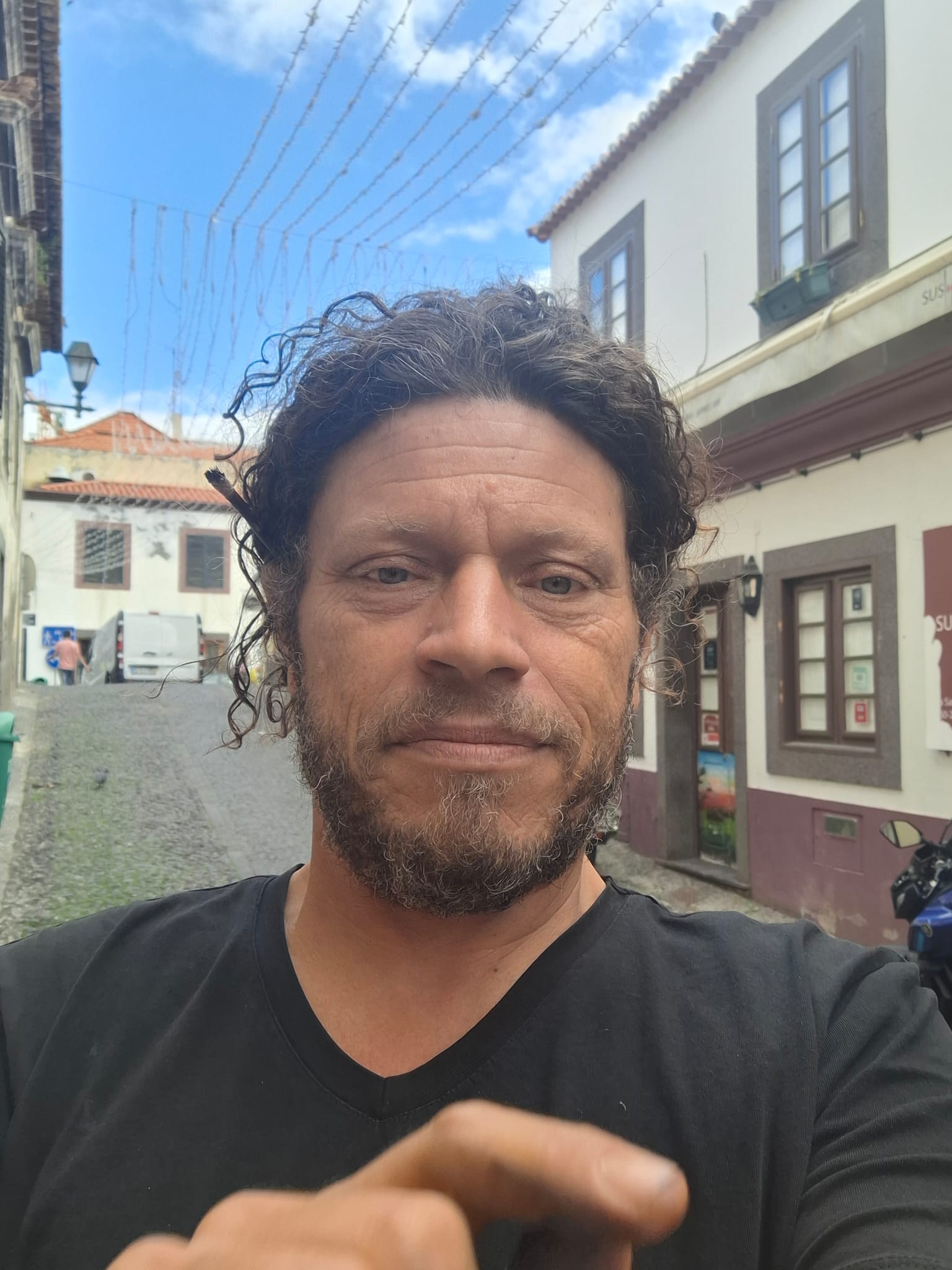
JEROEN SEBASTIAAN BUITENMAN 25-11-1973 Amsterdam The Netherlands
Self-taught
Oil paint and Sculptures
Jeroen Buitenman, (1973) Born and raised in Amsterdam the Netherlands. Left school at 16 years to start a painting company specialized in advertising paintings for a parfum company Douglas and developing further in TV decoration and interior art wall paintings in Europe, Morocco and Saudi Arabia.
Buying all Art books of all worlds biggest Artist created a self-taught art school and inspiration for his own style
Started in 1998 only concentrating on Oil painting in a Surrealistic style with influences of fashion and beauty brought from the parfum world. The first exposition was a big success so a big stimulation and new path was found. Moved to Portugal in 2007 for better light, and lives now on the flower island Madeira. The good light here makes it better to concentrate on technics and the never stopping learning process in combing colors. To continuing creating a surrealistic world in paintings.
So many different kinds of red, yellow, greens and blues
Moving to Madeira had a great influence on Buitenman. While his themes and imagery have not changed radically,the use of colour in particular has become even more intense
on this Portuguese ‘Isle of Flowers’. Buitenman: ‘You can take beautiful walks here and what you see in terms of colours is incredible. Just how many different kinds of red
there are.’ In contrast to his time in Amsterdam, Buitenman now works during the day, which means that light plays amore important role. As a result, his latest paintings sparkle
even more, they almost shine. Another consequence of the move is the influence the
different climate has on his working process: paint dries
faster in warmer climes. All this has made Buitenman even more mindful of his craft: he mixes paint, sets up thecanvas, rounds off and varnishes a painting, et cetera, with ever-increasing appreciation. He is using more oil paint inhis most recent paintings; on the one hand because that is a boon for the colours, which become more vibrant the more paint he uses, and on the other, because having a skin of paint makes the work more tactile: a thicker layer of paint increases the tangibility of the work and awakens in the viewer the idea that a painting is not only something to look at, but also something you would like to touch. This complements the sensuality of Buitenman’s work and at the same time expresses another, hitherto unmentioned aspect of his artistry: the fact that he is a sculptor as well as a painter.
In Madeira, Buitenman devoted less time and attention to his sculptures than he would have liked. Perhaps that is why his paintings seem to have converged with his sculptural
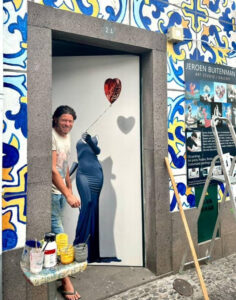
work, not only in the aforementioned tactility, but also in the shapes themselves. Many recent paintings depict a woman or just her outline in the form of a perfectlyfitting dress, which almost becomes a sculpture. It is as if Buitenman literally places beauty on a pedestal, but here, too, the tension between a brightly realistic way of painting and the surrealist representations is fully at play. You will never see the scenes Buitenman paints in real life, but at the same time, the paintings have a completely self-evident presence. This is true, this is real, but only insofar that something can be real in a dream.
That the representations in Buitenman’s paintings are compelling and elusive at the same time has another effect: the story, if you want to call it that, becomes ambiguous. There is something positive in these sculptures of women: the Statue of Liberty in New York, a beacon that shows skippers the way to a safe harbour, is a good example.
Equally, something menacing can be detected in the painting. Then that same voluptuous female form is actually deceptive, that beautiful dress that so effectively
shows the curves turns out to belong to one of the Sirens or to Lorelei, in any case to a woman who ensnares men and leads them into the abyss.
Voluptuous female bodies in tight-fitting dresses, brightly coloured stockings accentuating the graceful curves of their legs, flowers and birds both alluring and lush in form and colour: every element that Jeroen Buitenman uses to create the representations in his provocative paintings is familiar to the viewer, and seemingly sourced from everyday life, yet no one will ever see scenes such as these in reality.
Buitenman paints a world of his own making, one that is not so much an escape from reality as an optimistic counterpoint to the existing world. It is tempting to see
Buitenman’s canvases as utopias, as places that only exist in the imagination. Places that, precisely because of the painter’s inventiveness and his exuberant style, are also very
easy for the viewer to envisage. Places that, once seen in one of Buitenman’s paintings, materialise in the mind and remain there.
Buitenman’s faith in the power of his imagery grows constantly, he is bold enough to use colours as the great seducers they essentially are. The worlds Buitenman presents to the viewer are beyond time and therefore without pain. His titles used to be anecdotal or referred to politics or other current affairs. But he has since realised
that such references are actually obligatory; an artist does not have the monopoly on the truth. He can, however, use his art as a form of consolation by reminding the viewer
how much beauty there is in the world, how many beautiful flowers and birds, colours and shapes, how many beautiful women.
In Buitenman’s work, an exquisitely painted, beautiful dress is often enough to create an erotic tension; even when not accentuating the curves of a woman’s body, the dress is sensual in itself. Buitenman does not diminish.
From the book :As real as in a Dream
Author: Mischa Andriessen
Translation:
Mark Poysden
Jeroen Buitenman
